Ongoing Projects
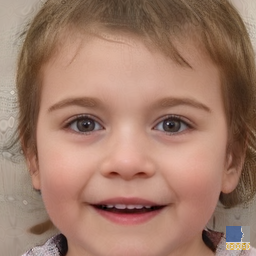
Photorealistic Synthetic Portraits
Here we show photorealistic synthetic portraits of certain rare diseases based on the cohort ... Read more
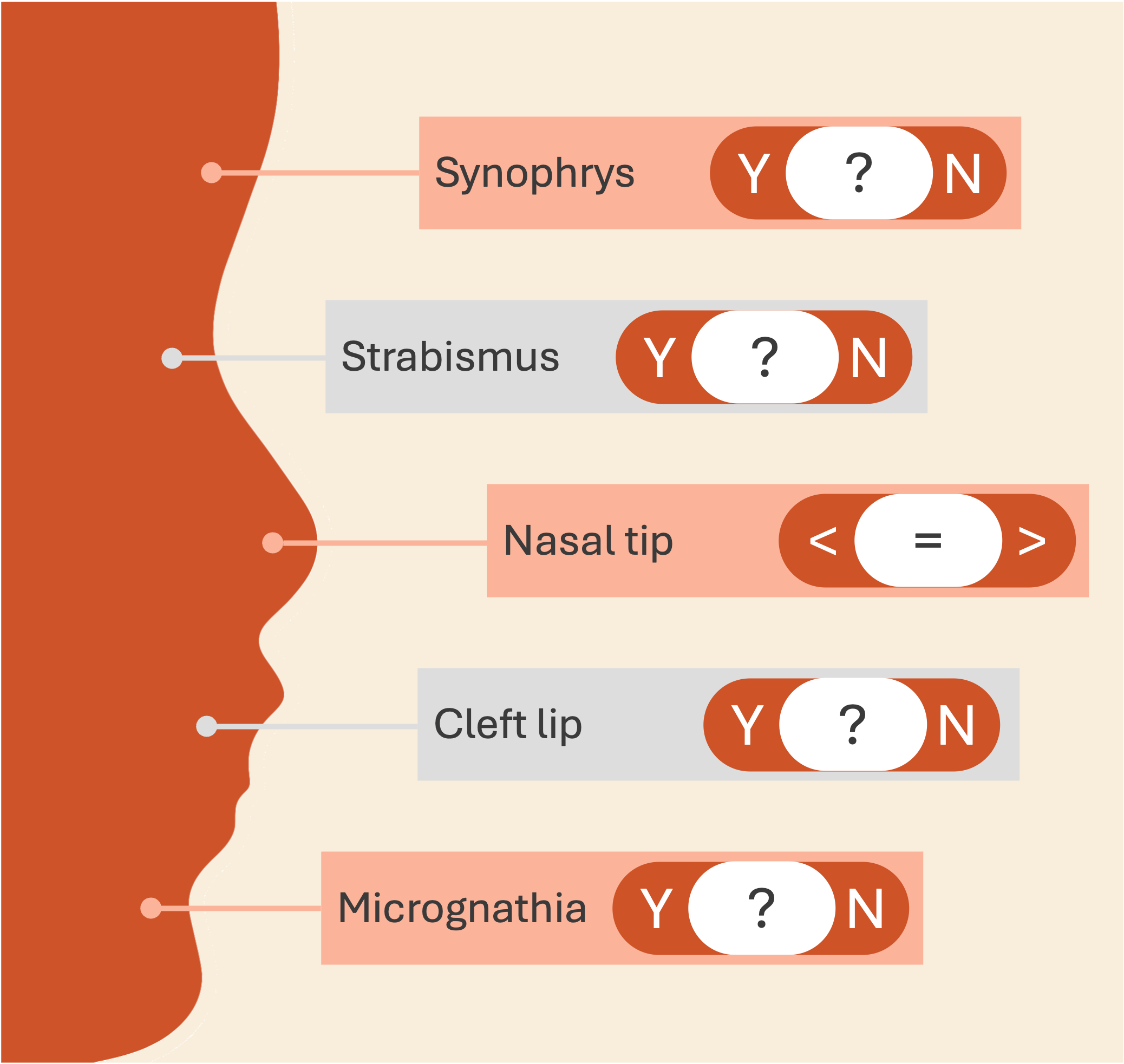
GMDB aims to improve the openness and accessibility of scientific findings and to enhance collaboration amongst researchers and clinicians. On this page, you can find all 34 active research projects approved since 2022 until today.
AI-Based Support for Early Diagnosis of Rare Genetic Disorders Using Facial Images
Oct. 2nd 2025
Principal Investigator: Mr. Akshit Chikara
Institution: National Institue Of Technology, Rourkela, India
We are conducting non-commercial academic research at the Department of Computer Science & Engineering, National Institute of Technology Rourkela, an Institute of National Importance in India. Our project develops and evaluates machine learning approaches to analyze facial images of rare genetic disorders to improve early diagnosis and support clinicians. We will also study explainability...
Read moreDetection and Interpretation of Genetic Disorders from Facial Phenotypes Using Explainable AI as a tool for screening
Nov. 17th 2025
Principal Investigator: Dr. abderrahim benmohamed
Institution: computer science department soukahras
Genetic disorders often present with distinctive but subtle facial phenotypical features, making computer-aided facial analysis a valuable diagnostic aid. Recent systems such as GestaltMatcher and DeepGestalt have demonstrated the feasibility of syndrome classification from 2D facial images, yet remain limited by their black-box nature. This research proposes a framework that both...
Read moreDetection and Interpretation of Genetic Disorders from Facial Phenotypes Using Explainable AI as a tool for screening
Nov. 3rd 2025
Principal Investigator: Ms. Ayat El Houda Kechroud
Institution: Souk Ahras University
Genetic disorders often present with distinctive but subtle facial phenotypical features, making computer-aided facial analysis a valuable diagnostic aid. Recent systems such as GestaltMatcher and DeepGestalt have demonstrated the feasibility of syndrome classification from 2D facial images, yet remain limited by their black-box nature. This research proposes a framework that both...
Read moreEnhancing Few-Shot Facial Phenotype Recognition Using ConvNeXt-v2 and AdaFace on the GestaltMatcher Database (GMDB)
Nov. 10th 2025
Principal Investigator: Mr. Hemant Darur
Institution: KLE Technological University
This project aims to improve few-shot facial phenotype recognition for rare genetic disorders using the GestaltMatcher Database (GMDB). We propose to enhance by integrating a modern ConvNeXt-v2 backbone with the AdaFace adaptive-margin loss function. The approach employs a meta-learning setup to better generalize across syndromes with limited data. The model will first be pretrained on...
Read moreRecognition of Genetic Diseases Based on Combined Feature Extraction from Face Images
Dec. 23rd 2025
Principal Investigator: Mr. Vyacheslav Kumov
Institution: Bauman Moscow State Technical University
The aim of the study is to develop methods for recognizing genetic syndromes from facial images. To improve interpretability, we propose a combined approach that uses both neural network features and geometric features from anthropometry. To extract geometric features, we plan to develop a method for reconstructing the 3D facial shape from a series of patient photographs. A separate...
Read moreUnsupervised Domain Adaptation Facial Phenotyping for Rare Genetic Disorders using GestaltMatcher Database
Dec. 23rd 2025
Principal Investigator: Dr. Farshid Hajati
Institution: University of New England
Next-generation phenotyping systems such as GestaltMatcher have shown great promise in supporting the diagnosis of rare genetic disorders from facial images. However, deploying these models robustly in real-world clinical environments remains challenging. In particular, performance can degrade substantially when models are applied to new hospitals, imaging devices, ethnic populations, or age...
Read moreThe typical facial Gestalt of Wiedemann-Steiner syndrome
Jan. 26th 2026
Principal Investigator: Prof. Carlos Steiner
Institution: Universidade Estadual de Campinas (Unicamp), Brazil
Wiedemann-Steiner syndrome (WDSTS; OMIM #605130) is characterized by neurodevelopmental disabilities, growth deficit, and distinctive facial features, with or without additional congenital anomalies that include cerebral, visceral, and skeletal malformations. The primary differential diagnoses include other chromatinopathies such as Cornelia de Lange syndrome, Kabuki syndrome, Rubinstein-Taybi...
Read moreExplainable Classification of Rare Diseases Based on Facial Phenotypes
Jun. 3rd 2026
Principal Investigator: Mr. 斌 权
Institution: Beijing University of Chemical Technology
We have previously developed a classification model for Goldenhar syndrome subtypes (96.8% accuracy), but it is limited to a single disease. With access to GMDB, we aim to extend our research to multi-disease rare disease diagnosis. The specific goals are: (1) Externally validate the cross-disease generalization of our existing model; (2) Build an assistive diagnostic model covering hundreds...
Read moreAgentic AI for Rare Disease Diagnostic Support with VLM-Based Phenotype Extraction from Facial Images
Jun. 3rd 2026
Principal Investigator: Prof. Pingzhao Hu
Institution: Western University (The University of Western Ontario)
Rare disease diagnosis remains a significant clinical challenge due to phenotypic heterogeneity and limited access to specialized expertise. In this project, we propose an agentic artificial intelligence (AI) framework for diagnostic support that integrates facial image analysis with structured phenotype information. Leveraging controlled access to the GMDB dataset, we combine compact visual...
Read moreAI-Based Vision Analysis of Photographs for Neuromuscular Disease Assessment
Jun. 3rd 2026
Principal Investigator: Prof. Sebastien Gaboury
Institution: Université du Québec à Chicoutimi
Our research project, Explainable Computer Vision for Rare Disease Identification from Facial, Hand, and Foot Morphological Data, aims to develop an interpretable AI-based diagnostic support system for identifying rare disease-related morphological patterns from non-invasive visual data. While the long-term objective is to build a multimodal pipeline integrating facial, hand, and foot images,...
Read moreFacial recognition for rare diseases
Jul. 1st 2026
Principal Investigator: Dr. Keru ZHENG
Institution: The Chinese University of Hong Kong, Shenzhen
Diagnosis of rare diseases has long faced the challenges of data scarcity and a lack of representative cases. The cost of diagnosing and treating rare diseases is extremely high. We aim to explore rare disease recognition using existing deep learning techniques. Specifically, we plan to build a multimodal large model for rare disease identification, integrating the OMIM database, rare disease...
Read moreDevelopment of software to support the diagnosis of genetic syndromes based on phenotypic data
Jun. 3rd 2026
Principal Investigator: Mr. Aidos Sadyrbekov
Institution: International IT University, Almaty, Kazakhstan
This project aims to develop a research prototype that, given a frontal facial photograph, returns a ranked short-list of candidate genetic syndromes with calibrated confidence scores — intended as clinical decision support, not a diagnostic device. The system will apply transfer learning from a face-pretrained backbone (ArcFace/VGGFace2-based ResNet) to classify five syndromes: Down syndrome,...
Read moreA Model for Early Detection and Classification of Genetic Syndromes in Asian Pediatric Population
Jun. 29th 2026
Principal Investigator: Dr. Sowmya P
Institution: Davangere University
Many patients with genetic syndromes have special facial and physical features, which boost significant potential value for clinical diagnosis. Deep Learning and Computer Vision technology can be employed to diagnose Genetic diseases by analyzing facial features of patients. In rural districts and resource limited areas access to specialized clinical geneticists is limited. Families often visit...
Read moreVariant Prioritization for Rare Diseases Using Multimodal Phenotype Integration
Sep. 25th 2026
Principal Investigator: Dr. MOHAMED BELMOKEDDEM
Institution: Research Centre for Scientific and Technical Information, Algiers, Algeria
Diagnosing rare genetic disorders remains a complex clinical challenge due to phenotypic variability and the vast volume of candidate variants generated by genomic sequencing. To address these limitations, we propose a multimodal variant prioritization framework that integrates computer-vision dysmorphology with machine-learning-based genomic analysis. This study fuses GestaltMatcher’s...
Read more