How do I interpret the results from the AI analysis?
When you analyze your patient’s photo with GestaltMatcher AI, the AI provides a ranked list of potential differential diagnoses.
Alongside each potential diagnosis, you will see several numerical measures. One of these is the GestaltScore, which reflects how similar your patient’s facial features are to other patients in GestaltMatcher Database (GMDB).
→ See also: What does the GestaltScore mean?
The way the results are displayed depends on whether you use the in the analysis tool in GMDB or the GestaltMatcher app:
Analysis tool in GMDB
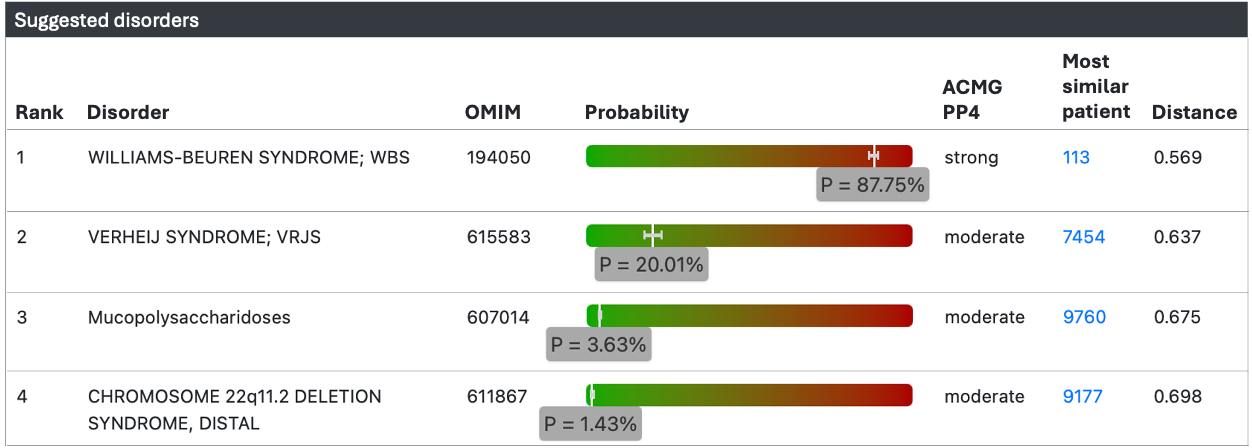
If you are accessing GestaltMatcher AI via the analysis tool in GMDB (Workbench → Analyze patient), the result shows GestaltScores, or distances. Here, the highest-ranked potential diagnosis will have the smallest distance, and the distances increase further down the list.
In short:
Lower GestaltScore = Smaller distance = Higher chance of having disease-causing variants in the same gene
This is an example of how the results of analyzing a photo with GestaltMatcher AI by using the analysis tool in GMDB look like:
GestaltMatcher app
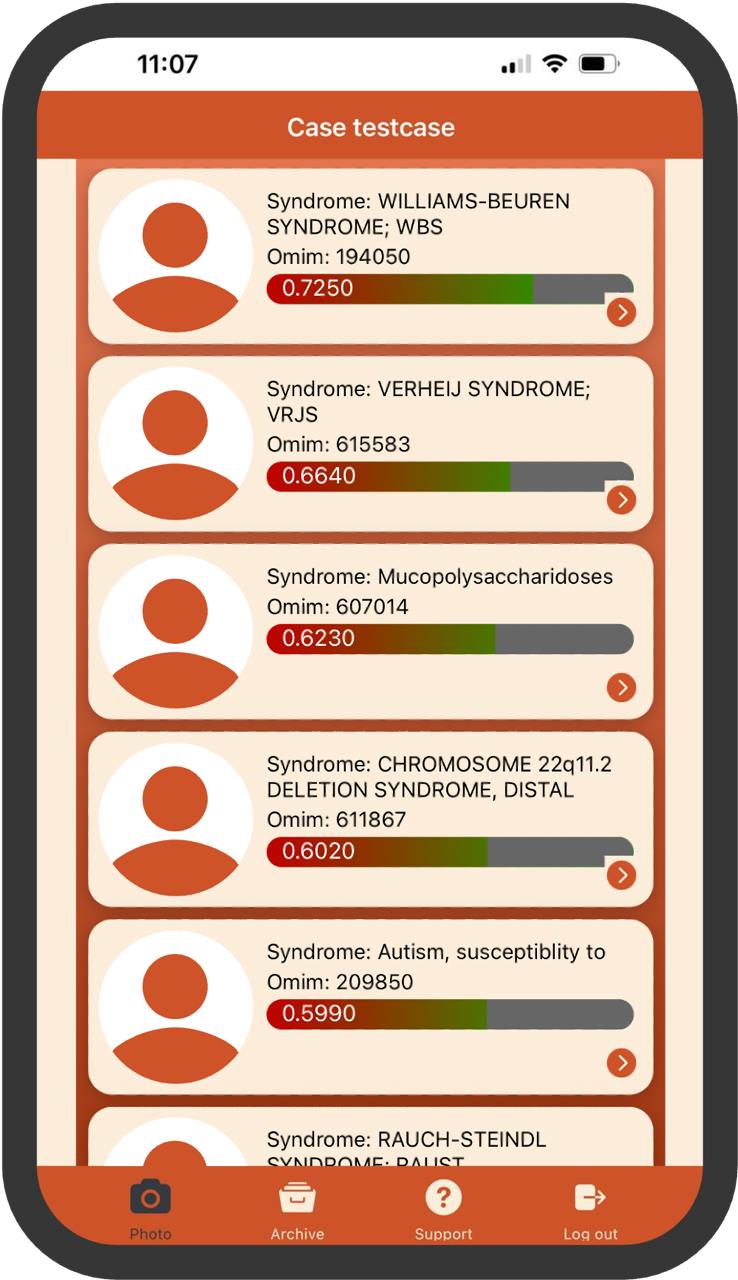
In the mobile app, the result shows similarity values instead of distances. Technically, the similarity is equal to 1.3 – distance. The highest-ranked potential diagnosis will have the largest similarity value, and the values decrease further down the list.
In short:
Higher similarity = Higher chance of having disease-causing variants in the same gene
This is an example of how the results of analyzing a photo with GestaltMatcher AI by using the analysis tool in GMDB look like:
We recognise this difference is not ideal and are working on a more consistent and user-friendly presentation of results:
Distances are not always straightforward to interpret and cannot be directly compared between syndromes. This is because some syndromes form more tightly clustered regions in the Clinical Face Phenotype Space than others.
To make results easier to interpret, we have developed a method to transform distances into probabilities, currently available only for the syndromes included in the GestaltMatcher AI training data.